
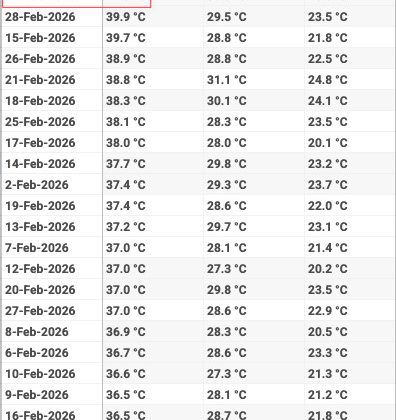

Tattamangalam, Palakkad district – February used to feel like a transition month. Not peak summer. Not yet the April furnace. But the recorded numbers from 2025 and 2026 tell a different story. This is not opinion. This is data.
Average Temperatures – Year Comparison
Average High
Feb 2025: 38.78°C
Feb 2026: 37.77°C
Average Mean Temperature
Feb 2025: 29.31°C
Feb 2026: 28.91°C
Average Low
Feb 2025: 22.30°C
Feb 2026: 22.56°C
At first look, 2025 was slightly hotter overall in daytime. But the real story is in the pattern, not just averages.
Extreme Heat Days
Days at or above 40°C
2025: 5 days
2026: 3 days
Highest Recorded Temperature
2025: 42.9°C
2026: 42.4°C
Both years crossed 42°C in February itself. That is not late-April heat. That is pre-summer touching extreme territory. 2025 had more sharp, intense spikes above 40°C – heat coming in stronger punches.
Night Temperatures – The Quiet Warning
Lowest Recorded Temperature
2025: 18.7°C
2026: 20.1°C
This matters. Even though 2026 had slightly lower daytime averages, the nights were warmer. The temperature did not drop as much. That reduces cooling recovery for people, crops, soil moisture, and livestock.
What the Pattern Suggests
2025
– More extreme daytime spikes
– Bigger day-night swings
– Classic intense dry-heat behaviour
2026
– Slightly lower peak highs
– Warmer nights
– Less cooling relief
– Possible increased heat retention or humidity influence
This shift from “spike heat” to “trapped heat” is subtle, but measurable.
The Bigger Point
Two consecutive February months crossing 42°C is not random weather drama. February in the Palakkad belt is no longer a gentle transition period. It is behaving like early summer.
When 40°C becomes a recurring February number, we are looking at a structural change in seasonal behaviour.
Climate change doesn’t always shout.
Sometimes it quietly shifts baselines.
And the baseline here is clear: February is getting hotter, and cooling relief is shrinking.
For more visit our dedicated weather section with live updates